
Howe To: Win the Strategic Global Awards
I won Internal Engagement Campaign of the Year at the inaugural Strategic Global Awards 2026 in Brussels.
Judges called my team's campaign "a masterclass in translating strategic intent into measurable business impact."
So what?
If you're an internal communications professional interested in winning next year's award or looking to borrow strategies and tactics for your next campaign, read on for:
My nomination submission, word for word
A never-before-published summary of The Action Framework I developed and used throughout the award-winning campaign
1. My nomination submission, word for word
Award Category
☐ Integrated Strategic Communication Campaign Awarded to campaigns that unify multiple channels and strategies for maximum impact.
✅ Internal Engagement Campaign of the Year Celebrates campaigns that enhance employee engagement and organizational culture.
☐ Change Communication Campaign of the Year Honors campaigns that guide organizations through transformation or change.
(NOTE TO READER: They kept guidance simple. What you see here is the full nomination submission detail requested.)
Entry Details
Overview of campaign:
BAYADA's 2025 Awards Weekend presented a distinct communication challenge: how do you drive confident participation in a first-ever West Coast event requiring air travel for most of the 4,000 invitees—while maintaining home health care client coverage across 22 U.S. states and six countries?
The eight-month campaign supported long-distance travel planning amid real external uncertainty, including nonstop headlines about air travel crises and active wildfires in L.A. starting right before registration opened. Many employees had limited experience flying for work, and local offices needed to maintain uninterrupted client care throughout.
The communication strategy combined leader enablement, employee communications, and continuous listening so leadership decisions could adjust in real time. Frequent formal and informal listening touchpoints surfaced risks early, informed leadership tradeoffs, and enabled rapid adjustments to both communication and operational strategy.
Success was measured through action, preparedness, trust, and connection. The campaign sustained strong participation and confidence while intentionally reducing communication volume, prioritizing fewer, better-timed messages aligned to key decision points.
Objectives and strategic approach:
Business objective:Reinforce connection and retention across more than 380 home health care offices by delivering a high-participation in-person event without compromising client coverage.
Communication objectives:
Enable confident early registration (first 24 hours)
Reduce uncertainty around long-distance travel
Establish clear expectations for coverage, travel, and participation
The strategy emphasized sequencing and coordination. Leaders received advance guidance and enablement materials to support consistent expectations. Messages were aligned to employee decision points—office coverage planning, registration, and travel booking.
Listening was embedded throughout the campaign and reviewed in structured every-other-week reporting discussions to inform leadership decisions and mid-course adjustments. Communications were coordinated across enterprise, local, and event teams using a shared strategic plan and schedule to manage volume and avoid overlap.
Measurable results / impact:
Early action: ~31% of 2,500 eventual attendees registered on day one of a four-week period, signaling clarity and confidence despite travel and office coverage constraints and the introduction of a new third-party travel partner.
↳ Attendance context: Attendance (61%) exceeded a projected 5% YoY decline from 64%.
Trust: Eleven employee information sessions averaged a +74 Net Promoter Score—particularly notable given that one in five respondents expressed uncertainty about travel (80% preparedness pre-event).
Preparedness: 95% of attendees reported feeling prepared to travel.
Connection: 95% felt more connected to colleagues following the event.
↳ Retention context: Employees with stronger employee experiences are 8x more likely to stay (McKinsey). While no single campaign drives retention, measuring trust and connection as leading indicators reflects a strategic shift in how we define campaign success.
Listening insights informed ongoing adjustments, supporting early action and sustained confidence as conditions evolved.
Creativity and innovation demonstrated:
We used a disciplined planning, listening, and reporting framework to make better decisions amid uncertainty and reduce noise.
Better decisions
Wildfires dominated headlines in January. Rather than issuing a broad, reactive message immediately—which risked amplifying anxiety—we paused to listen. I BCCed 14 colleagues across roles, business lines, and geographies to understand what employees were hearing and feeling.
That feedback led to two decisions:
Quickly publish a short article acknowledging the fires and reinforcing confidence in planning, monitoring, and message update processes.
Quietly plan a community service activity for the May event.
Effectiveness was assessed through anecdotal feedback across roles and geographies, reinforced by early registration behavior and post-event survey comments. The community service activity received positive mentions as a signal of connection and organizational values.
Less noise
A second outcome was reduced communication volume through tighter sequencing and cross-functional coordination. For example, enterprise, business line, and event teams shared plans to avoid scheduling overload.
(NOTE TO READER: 156 words…whoops!)
Supporting documents / media (optional)
Case study article: How We Got 2,500 Employees to LA: What I Learned Putting My Comms Framework to the Test
Presentation slides
NOTE TO READER: Joanna Parsons saw my article (I shamelessly sent it to her!) and invited me to share my framework with her Curious Tribe of international IC leaders. I did a 45-minute deep dive on measuring and reporting on what matters, with a focus on what happened when the L.A. fires erupted during the Awards Weekend campaign. I submitted that slide deck with my submission.
2. A never-before-published summary of The Action Framework I developed and used throughout the award-winning campaign
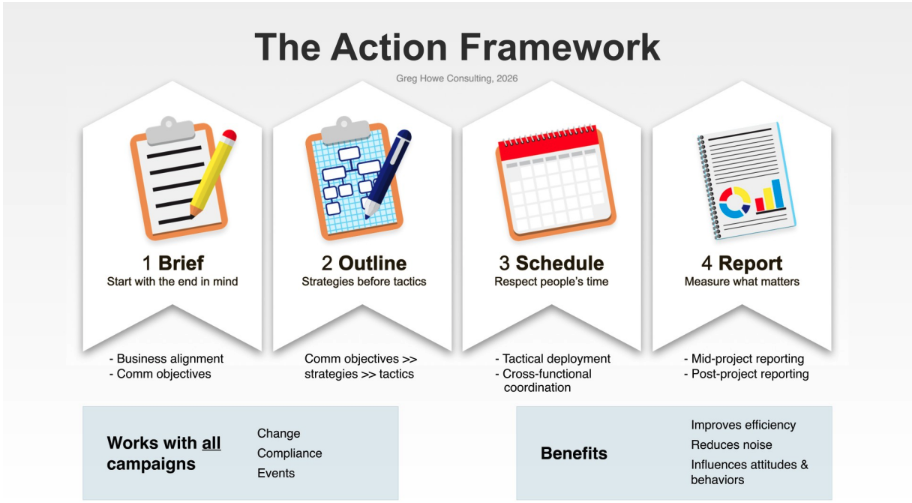
The Action Framework is my project management-inspired communications framework—Brief, Outline, Schedule, Report—built on four principles: start with the end in mind, strategies before tactics, respect people's time, and measure what matters.
The principles are universal and scalable.
Written by Greg Howe, a communications professional who thinks like a project manager. He led large-scale change at a 30k-employee healthcare organization for more than 15 years. Based near Philadelphia, he helps leaders turn strategy into action and writes about the frameworks needed to do it. Follow him on LinkedIn or book a 20-minute call to talk shop.