

How to read the 2026 Gartner Magic Quadrant for Workplace Experience Applications if you're a communicator
The 2026 Gartner Magic Quadrant for Workplace Experience Applications (WEX) came out in April. You may not have seen it. But that doesn’t mean you shouldn’t pay attention to it.
This isn't a report communicators typically follow. It sits closer to facilities management, IT and real estate.
But it should be on your radar, and here's why: companies are rewriting return-to-office policies faster than they're communicating them, and the physical office experience is now a direct factor in whether employees trust that leadership understands what they need.
That's a communicator's problem. WEX tools are part of the infrastructure that shapes that experience. And several vendors on this report will already look familiar.
What is the Gartner Magic Quadrant for Workplace Experience Applications?
Gartner defines this category as applications that help employees plan office days and interact with the physical workplace. That means desk and room booking, wayfinding, hybrid schedule coordination, occupancy analytics, and increasingly, AI-driven recommendations about when and where to work.
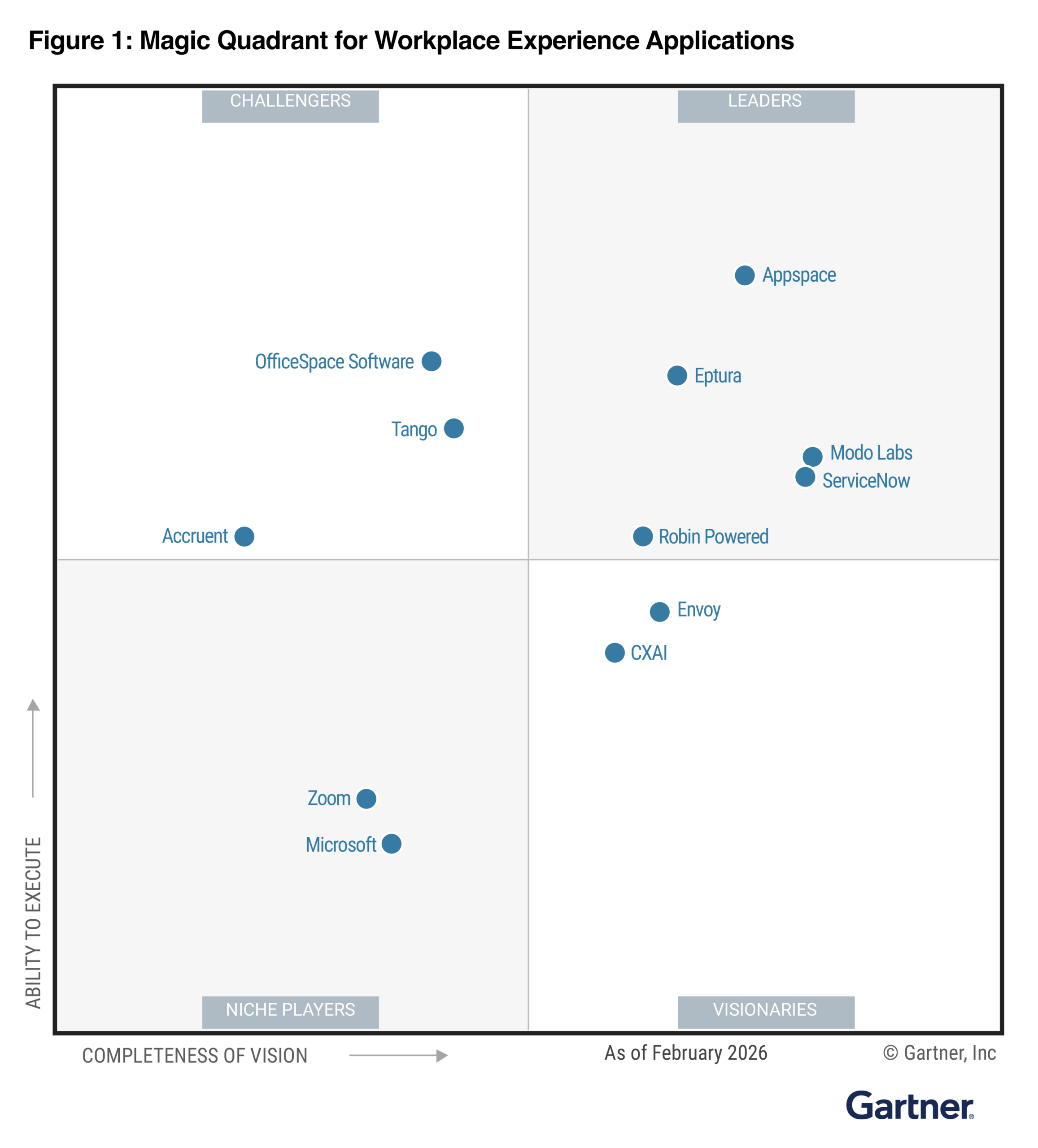
The report evaluated 11 vendors across the “Ability to Execute and Completeness of Vision,” sorting them into the familiar four quadrants: Leaders, Challengers, Visionaries, and Niche Players.
The audience Gartner wrote it for is enterprise application leaders - IT and facilities decision-makers, primarily. Communicators aren't typically the target buyer. But as hybrid work has made the physical office part of the employee experience story, these tools are landing in the same conversations as your comms stack.
Who are the 2026 Gartner Magic Quadrant Leaders?
Gartner named five Leaders: Appspace, Eptura, Modo Labs, Robin Powered, and ServiceNow.
Five Leaders out of 11 evaluated vendors. That's a dense Leaders quadrant for a market that's still maturing, and it signals that the foundational capabilities - booking, wayfinding, presence tracking - are largely table stakes now. The differentiation is moving to AI, integration depth, and how well a platform connects the physical workplace to the rest of the employee experience.
The names you'll recognize
This is where it gets interesting for communicators.
Appspace shows up in this quadrant as a Leader. If you followed our coverage of the Gartner Magic Quadrant for Intranet Packaged Solutions, you saw Appspace there, too, as a Challenger. The same company, evaluated across two entirely different Gartner reports, in two different categories. Appspace spans digital signage, employee communications, and now workplace experience.
For organizations thinking about platform consolidation, Appspace appearing in both the intranet and WEX quadrants is worth paying attention to. Digital signage, employee communications, and workplace experience in one platform is a meaningful argument against the three-vendor, three-team approach a lot of organizations are currently running.Microsoft is in this quadrant as a Niche Player with a product called Microsoft Places. It's built into Teams and Outlook - hybrid scheduling, desk booking on floor maps, attendance insights. If your organization runs on Microsoft 365, Places is probably in your contract. That doesn't mean it's being used. Gartner notes that Microsoft declined to provide supplemental information for the evaluation, and that the feature depth and production references "are still developing."
Zoom is also here, as a Niche Player, with Zoom Workplace. If you work with Workvivo - Zoom's employee communications platform - you're already in the Zoom ecosystem. Zoom Workplace handles desk and room booking, visitor management, and AI-assisted scheduling. Gartner calls out that its WEX-specific sales motion and marketing are still maturing relative to its core collaboration products.
ServiceNow is a Leader. For organizations where ServiceNow already owns IT service management and HR workflows, its Workplace Service Delivery product connects reservations and space management to the same platform running everything else. The caution Gartner flags is real: onboarding is complex, and WEX-specific case studies are hard to find.
Why communicators need to be in this conversation
Gartner's market overview uses a phrase that should land hard for anyone in IC right now: "earn the commute."
Organizations aren't just trying to fill desks. They're trying to justify asking people to give up time, money, and flexibility to come in. The experience employees have when they arrive — whether they can find a desk, locate their team, book a room without three workarounds, or even just navigate a floor they haven't been on in six months — is part of what makes that trade feel worth it or not.
Communicators have been living in the "earn the commute" conversation for years through messaging, culture, and leadership visibility. WEX tools are the operational layer underneath all of that. They're what happens before your message lands.
Internal communicators talk a lot about employee experience, but we tend to mean communications-driven experience: the right message, the right channel, the right time. The physical experience is just as real. When an employee commutes 45 minutes, can't find a quiet space to take a call, and spends 20 minutes figuring out how to book a conference room, no amount of good internal comms recovers that morning.
With RTO policies tightening across industries, the stakes on this are only going up. Companies that mandate office days without fixing the in-office experience are going to hear about it, and communicators will be the ones fielding the response.
This is a conversation our field should be leaning into, not leaving entirely to facilities and IT.
How to use the report
The quadrant image gets the attention, but the strengths and cautions sections are where the useful detail is. Each vendor gets a few paragraphs. The cautions tend to be more honest than most of what you'd hear in a sales conversation.
A few patterns worth noting across this report: several vendors have strong North America footprints and weaker global coverage. Several have AI features that are genuinely differentiated and others where "AI" is doing a lot of marketing work for a thin capability. And at least two vendors in this report — Envoy and Microsoft — declined to provide supplemental information for the evaluation. Gartner notes when that happens. It's worth noting when you're evaluating.
The full report requires a Gartner subscription, but several vendors make it available as a free download. ICology obtained our copy from Appspace. Download the report.
One question worth adding to vendor conversations
WEX platforms often get bought by facilities or IT and then handed to communicators to help drive adoption. If that's happened in your organization, or if it's about to, ask the vendor this: what does employee-facing communication look like at launch, and who typically owns it?
The answers vary a lot. Some vendors have mature playbooks for change management and adoption communications. Others treat go-live as an IT deployment milestone and assume the rest works itself out.
That assumption is where adoption goes to die.
If you want a fuller list of questions to bring into vendor conversations, we published a guide for that.
The 11 vendors evaluated in the 2026 Gartner Magic Quadrant for Workplace Experience Applications
Here's the complete vendor list, organized by quadrant.
Leaders
Challengers
Visionaries
Niche Players
Frequently asked questions
Who are the Leaders in the 2026 Gartner Magic Quadrant for Workplace Experience Applications?
Gartner named five Leaders: Appspace, Eptura, Modo Labs, Robin Powered, and ServiceNow.
How many vendors did Gartner evaluate?
Eleven, across four quadrants: Leaders, Challengers, Visionaries, and Niche Players. Three vendors — Johnson Controls, Korbyt, and Ricoh — received honorable mentions but did not qualify for inclusion.
What is a Workplace Experience Application?
Gartner defines WEX applications as tools that help employees interact with the physical workplace: desk and room booking, wayfinding, hybrid schedule coordination, occupancy analytics, and related capabilities
Why should communicators care about this report?
The physical office experience is part of the employee experience story, and with RTO policies tightening across industries, that connection is getting harder to ignore. WEX tools shape what employees encounter when they actually show up to work. Communicators who leave that conversation entirely to facilities and IT are missing a piece of the experience they're trying to influence. Several vendors in this quadrant also appear in reports communicators follow closely, including Appspace (a Challenger in Gartner's Intranet Packaged Solutions MQ) and Zoom (whose Workvivo platform is widely used for employee communications).
When was the 2026 Gartner Magic Quadrant for Workplace Experience Applications released?
April 2026.
Is the Gartner Magic Quadrant free?
Not directly from Gartner. Appspace has made the report available as a download through their website.
Does ICology have any relationships with vendors in this report?
ICology has partnership relationships with Appspace and Zoom.