

Your AI Strategy Has a $161 Billion Coordination Problem
The report doesn't mention internal communications once. But it describes the internal comms problem almost word for word.
Atlassian's State of Teams 2026 surveyed 12,035 knowledge workers and 172 Fortune 1000 executives. Its message is clear: AI delivered on speed. The coordination fallout is something else entirely.
89% of executives say AI has increased the speed of work. Only 6% can point to specific ROI. The gap between those two numbers is where internal communicators need to live.
The fragmentation tax
The report introduces a concept worth remembering: the fragmentation tax. When AI accelerates individual output without the team structures to absorb it, you get duplicative work, misaligned priorities, and coordination breakdown. The cost to the Fortune 500 is an estimated $161 billion a year.
Knowledge workers spend 80% of their time on collaborative work. But only 24% of AI implementations focus on teams. The math on that doesn't work, and the research confirms it.
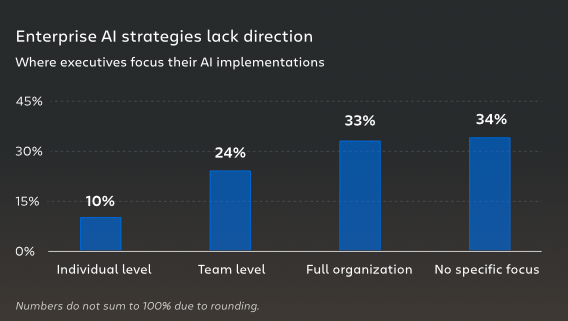
87% of knowledge workers say that with everyone in execution mode, they often lack time or capacity to coordinate. 84% have unclear or conflicting goals. 71% find other teams working on duplicate projects.
The workslop problem
One of the more useful concepts in the report is "AI workslop" — low-quality, unverified outputs that require more work to fix than they saved to create. 49% of knowledge workers say AI outputs aren't reliably high-quality. Nearly half admit their AI use requires compromising between speed and quality.
This hits IC practitioners on two levels. First: you're probably seeing it in your own work. The AI;DR problem is real — employees can tell when something was generated and nobody checked it before it landed in their inbox. Second: employees across your organization are producing workslop, and sometimes it's reaching leadership. That's a credibility drain nobody needs
The trust gap is IC's jurisdiction
Only 22% of knowledge workers fully trust their AI tools to produce accurate, high-quality deliverables. 69% say their data and knowledge foundations aren't optimized for AI.
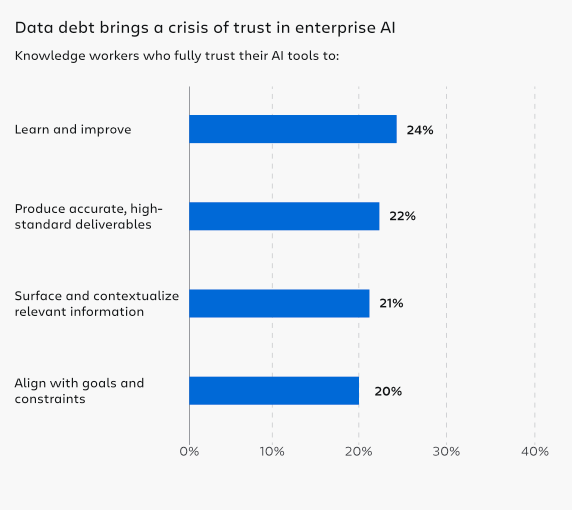
When employees don't trust the information they're working from, they default to one-off pings, redundant meetings, and informal verification loops. Communication volume goes up. Signal goes down.
Building trust in AI tools isn't a job for IT alone. The narrative around how AI is being used, what it's good for, and where human judgment still belongs — that's IC's lane.
Three things top teams do differently
The report identifies what separates high-performing, AI-enabled teams from the rest, and it maps almost exactly onto what good IC practitioners already do.
Top teams invest in context: shared goals and accessible, trusted knowledge. They're 12x less likely to experience unclear or conflicting priorities, and 7.3x more likely to have knowledge foundations their people and AI tools can actually rely on. In IC terms, this is communication strategy, goal cascades, and keeping employees oriented on what matters.
They design clear workflows for how work moves across people and agents — and they do it intentionally. Top teams are 13x more likely to say everyone's aligned on how and where to use AI, and 7.7x less likely to say there's no time to coordinate. The report specifically calls out the value of "communication rituals" and asynchronous defaults. IC has been building these for years.
They build cultures that treat AI as a teammate, not a threat. Top teams are 2.3x more likely to view AI this way. Shaping that perception is storytelling work, leadership voice work, and sustained internal communication.
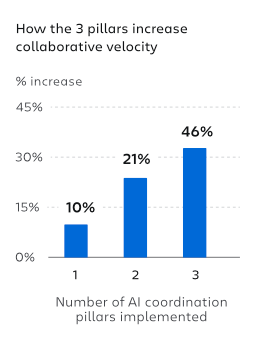
Teams that implement all three pillars cut the fragmentation tax by 46%. Only 14% of organizations get there.
What to do with this
Start by auditing whether your own AI communication is producing workslop. Speed isn't a virtue if employees can detect the bot before they finish the first paragraph. Keeping communication credible in an AI era is now a baseline skill for this function.
Get involved in the context work. Shared goals, centralized knowledge, clear priorities — this is where the research shows the biggest ROI gaps exist. If your organization doesn't have an IC strategy around what AI is for and how progress gets communicated, you're contributing to the fragmentation tax by staying quiet.
Make the capability gap visible to leadership. 55% of executives say AI has widened performance and opportunity gaps across teams. Knowledge workers are 90% more likely to fear being unprepared for AI than fear job displacement itself. That's a story leadership needs to hear. IC is often best positioned to tell it.
The AI conversation in most organizations is happening in IT and at the C-suite level. The coordination conversation — which is fundamentally the communication conversation — is lagging. This research makes the case for why IC needs a seat at that table and what to bring when it gets there.