

The One-Person Internal Comms Team Survival Guide
You're the entire internal communications function. You write the emails, build the decks, manage the channels, advise the executives, plan the town halls, field the last-minute requests, and somehow find time to think about strategy. There's no team to delegate to. No backup when you're on PTO. No one who fully understands what you do all day.
You're not alone in this. According to Gallagher's State of the Sector, 72% of organizations with an internal comms function have fewer than five people on the team. Many have exactly one.
This post is for you. Not theory. Not a list of tools to buy. Instead it’s practical guidance for doing meaningful work when you're the only one doing it.
Accept that you can’t do everything (and stop trying)
The fastest way to burn out as a solo communicator is to say yes to everything. Every department wants help with their announcement. Every leader wants their message to go company-wide. Every initiative needs "comms support."
If you try to service all of it, you'll spend your weeks producing content nobody asked employees if they wanted, and you'll have zero time left for the work that actually moves the organization.
Draw a line. Not every request deserves the same level of effort. Some things get the full treatment. Some get a template and a "good luck." Some get a polite no.
You are not an internal content factory. You're a communications strategist who happens to also execute. If leadership doesn't understand that yet, part of your job is teaching them.
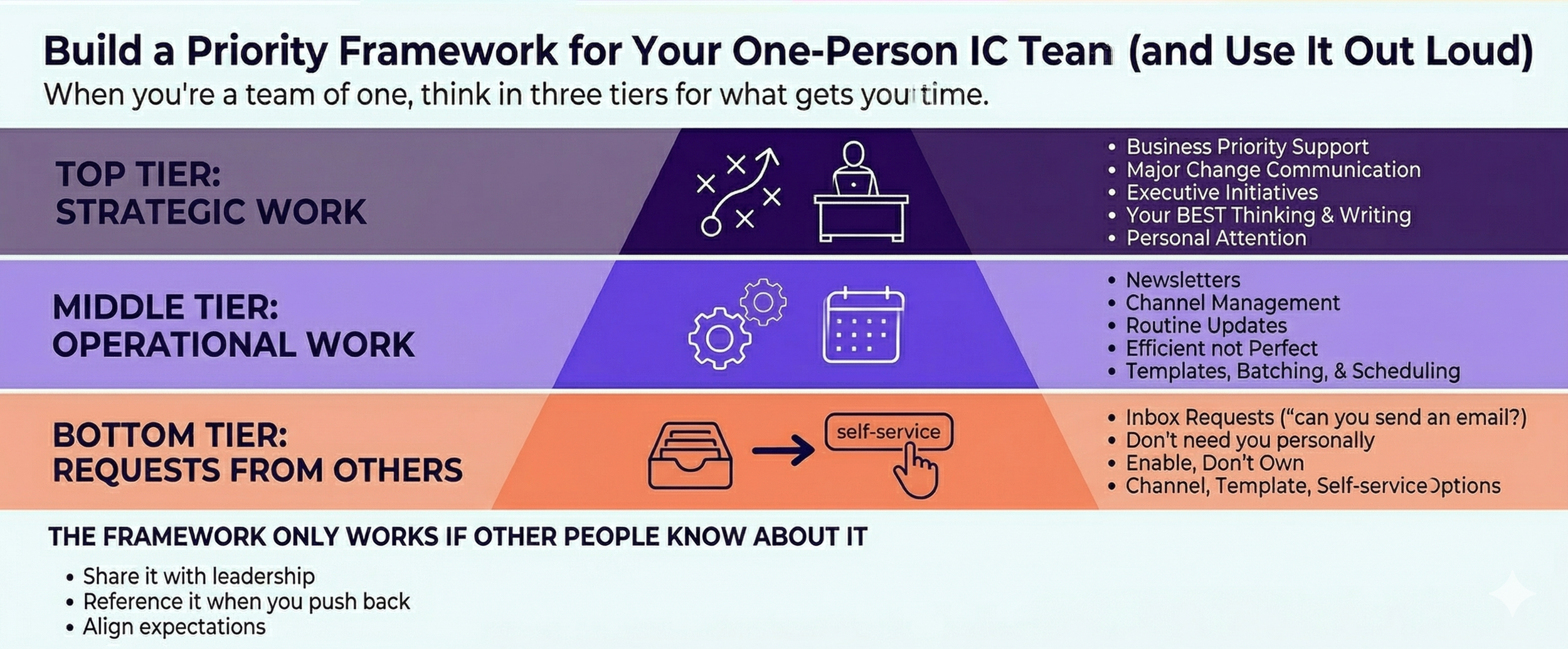
Build a priority framework for your one-person IC team (and ust it out loud)
When you're a team of one, you need a simple system for deciding what gets your time. Think in three tiers.
Top tier is strategic work. Communications that directly support a business priority, a major change, or an executive initiative. These get your best thinking, your best writing, and your personal attention.
Middle tier is operational work. Recurring communications that keep the organization informed: newsletters, channel management, routine updates. These need to be efficient, not perfect. Templates, batching, and scheduling are your friends.
Bottom tier is requests from others. The "can you send an email about this?" messages that fill your inbox. Most don't need you personally. They need a channel, a template, or a self-service option. Your job is to enable these, not own them.
The framework only works if other people know about it. Share it with your leadership. Reference it when you push back on a request. "That's a bottom-tier request, so here's a template you can use" is a complete sentence.
How to build allies when you’re a team of one
Solo doesn't mean isolated. Every organization has people who can extend your reach without being on your team.
HR communicates with employees constantly through benefits enrollment, policy updates, and onboarding. If you're not aligned on messaging cadence and channel usage, you're either duplicating effort or contradicting each other. Either way, it costs you.
IT controls the platforms and often has data on how employees actually use the tools you're communicating through. Marketing has design skills and content tools that can be adapted internally. Executive assistants know what's on leadership's radar before anyone else does, which means they can give you early warning on announcements that will eventually land on your plate.
Managers are your distribution network. You can't reach every employee directly. The more you equip them with clear talking points and context, the less you have to do yourself.
You don't need these people to report to you. You need them to know you exist, understand what you do, and see you as someone who makes their job easier.
Protect your strategy time
This is the hardest part. When you're executing all day, strategy gets pushed to "when I have time," which means never.
Block time on your calendar for thinking. Not writing, not responding to Slack, not building slides. Thinking. Even two hours a week makes a real difference.
Use that time to ask yourself three questions: What's working? What's not? What should I stop doing?
That last one matters most. Things accumulate without you deciding they should. A monthly newsletter nobody reads. A channel three people use. A recurring meeting where you present updates nobody acts on. Every one of those is time you could spend on something that matters. The ICology Kano Comms Audit is a free tool built specifically to help you pressure-test what's worth keeping.
Audit ruthlessly. Kill what isn't working. You don't have the luxury of carrying dead weight.
Say no to “urgent” most of the time
When you're the only comms person, everything gets routed to you as urgent. A VP needs an email sent today. Someone wants a last-minute slide for a town hall. A policy change needs to be communicated "immediately."
Most of these aren't urgent. They're late.
Someone didn't plan ahead, and now they need you to absorb the consequences. That's not an emergency. That's a process problem.
You can help in the moment when it genuinely matters. But if you make a habit of dropping everything for last-minute requests, you're training the organization to never plan ahead, and you'll never get ahead yourself.
A simple response that works: "I can get to this by [realistic date]. If it needs to go out sooner, here's a template you can use today."
Use AI where it helps
If you're a solo IC practitioner and you're not using AI for first drafts, summaries, and repurposing content across channels, you're working harder than you need to.
AI won't replace your judgment, your relationships, or your understanding of your organization's culture. But it can cut the time you spend on a first draft from 45 minutes to 10. It can summarize a leadership meeting into key messages. It can help you turn a long-form article into a short intranet post and a manager talking point.
The time you save on production is time you can spend on the work that actually needs a human.
Start small. Pick one recurring task that eats your time and see if AI can handle the first 80% of it. You'll know quickly whether it works. ICology's free tools were built with exactly this kind of practitioner in mind, including an Employee Persona Builder and a Meeting Cost Calculator that can help you identify where your time is actually going.
Set expectations early and often
The biggest mistake solo communicators make isn't tactical. It's failing to set expectations with leadership about what one person can realistically deliver.
If your leadership thinks you can run an intranet, write a weekly newsletter, support six departments, manage a channel strategy, handle crisis comms, and advise the CEO, they don't have unreasonable expectations. They have uninformed ones.
That's fixable. But you have to fix it.
Put together a simple one-page summary of what you do, how long it takes, and what you're prioritizing this quarter. Share it with your boss. Update it regularly. When new requests come in, point back to it.
Most leaders have no idea how long a good employee communication takes to plan, write, review, and distribute. Show them. The work becomes a lot harder to ignore when it's visible.
Find your community before you need one
IC burnout is real, and solo practitioners are especially vulnerable. You're absorbing organizational stress all day. You're often the person who knows about layoffs or restructuring before anyone else. There's nobody on your team to vent to.
Find your peers. ICology exists for exactly this reason, a community of practitioners who understand the work and aren't interested in vendor fluff or surface-level conversation. Other IC communities and professional associations are worth your time too.
Take your PTO. Set an out-of-office that doesn't apologize. The organization will survive a few days without comms support. If it can't, that's a staffing problem, not a vacation problem.
Other asked questions…
What should a one-person IC team prioritize? Strategic work that ties directly to a business priority. If a request doesn't connect to something the organization is actively trying to do, it can wait or get a template. The priority framework above gives you a simple way to sort what lands on your plate.
How do I push back on requests when I'm the only IC person? A written priority list shared with your leadership is the most practical tool you have. When a new request comes in, you can respond with "Here's what I'm currently focused on. Where does this fit?" instead of absorbing it or just saying no.
Can AI actually save time for a solo IC practitioner? For production tasks, yes. First drafts, repurposing content, summarizing meeting notes: AI handles the first 80% faster than you can get started. The judgment, tone-setting, and organizational context still need you. Start with one recurring task and see what happens.
Written by Chuck Gose, founder of ICology.