

TL;DR:
Half of employees say message volume is fine. 44% still tune out - that's passive disengagement, not overload. Trust comes down to who sends the message, not which channel.
When official channels fail, employees don't stop getting information; they just go somewhere else.
AI should reduce noise, not produce more of it.
And digital signage is the most underused low-friction channel most organizations already have.
A new study from Korbyt and Reworked surveyed more than 1,100 workers on how they experience workplace communication. The headline finding sounds almost paradoxical to what most communicators are saying: half of respondents say the number of messages they get is "about right," yet many still tune out.
44% of employees tune out, even when they say message volume is "about right."
Half of workers say message volume is fine. 44% still tune out. Passive disengagement is harder to fix than outright overwhelm. When employees stop noticing they're overwhelmed, satisfaction scores start lying to you. The report makes this point directly: 89% of workers are only moderately confident they aren't missing important updates. That number should make every internal communicator reflect.
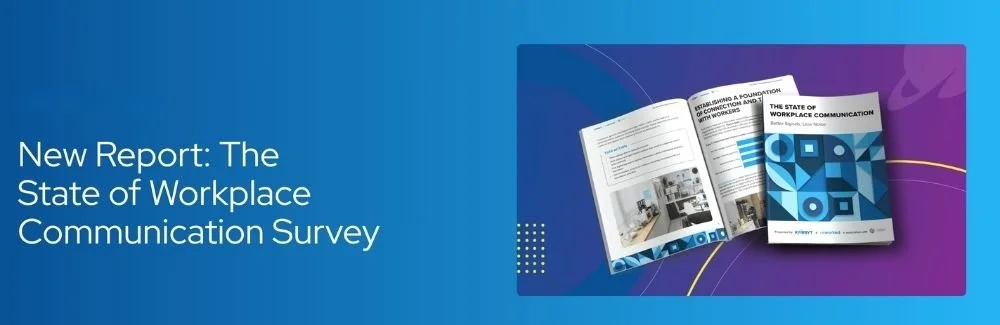
ICology is proud to have been part of this research. The full report, Better Signals, Less Noise: The State of Workplace Communication, is now available, and there's a lot in here worth your time.
What the data says
Workers aren't asking for less communication. They're asking for communication that does something. 57% pay attention when a message is timely or urgent. 56% engage when clear action is required. What makes them tune out? Repetition across channels. Vague, generic messages. Content that could've been sent to anyone.
The report offers a simple test worth keeping: before any message goes out, you should be able to finish this sentence - "After reading this, employees will ___." If that blank is hard to fill, the message isn't ready.
73% of workers say who a message comes from is the top factor in whether they trust it.
The trust piece is worth sitting with. 73% of workers say sender identity is the top factor in whether they trust a message. "From the Leadership Team" doesn't cut it. People trust people, not titles. We wrote about this recently in the context of leaders who can't admit mistakes - when leadership messaging loses credibility, IC carries the weight of that gap. This data confirms the gap is real and it starts with who signs the message.
The report also flips a common IC assumption about what makes employees feel connected. When asked what communication content builds connection, 50% pointed to clear operational updates - what's happening, what's changing, what they need to do. Recognition content came in at 42%. Purpose and mission messaging at 40%. Feel-good content has its place, but employees feel most connected when they understand what's actually going on. That's a useful gut check before defaulting to a values campaign when trust is low.
Direct managers are the missing link most organizations keep overlooking. Employees trust their manager more than any executive or channel. If managers aren't equipped to cascade and add context, no amount of polished all-staff emails will close the trust deficit.
And then there's the shadow comms finding, which anyone who's worked in internal comms will recognize immediately. When official channels fail, employees don't stop getting information - they just go somewhere else. Slack DMs, WhatsApp groups, text messages, hallway conversations.
If workers are getting their real news from unofficial channels, that's a signal about your official ones. Unofficial channels are faster, easier, and more specific to people's actual jobs. The only way to compete with that is channel discipline - giving each channel a defined role and actually sticking to it.
On AI: reduce, don't produce
Most workers don't care if a message was written by AI, until it adds to the noise. 45% already question the accuracy of a message when they suspect AI was involved.
92% of workers agree: AI should reduce information overload, not increase message volume.
The moment AI is used to generate more, workers trust less. The report puts it plainly: if you use AI to do more, you get AI wrong. Employees want AI to summarize, deduplicate, and prioritize - not produce a higher volume of content that sounds like it came from a template.
We've been tracking this shift at ICology. The AI;DR post from earlier this month gets at the same problem from a different angle: employees already had a reflex to tune out communications that feel inauthentic. AI just made it easier to generate more of the content that triggers that reflex. The research here backs that up with numbers.
One more number worth sitting with: 81% of workers say they can usually tell when a message was written by AI. They're not fooled, and most don't care until it adds to the noise.
When asked where AI could genuinely help, employees were clear:
Summarizing long or complex information (54%)
Reducing duplication across channels (42%)
Prioritizing what matters most (40%).
That's a pretty specific job description. AI as editor and filter. Not AI as author.
The transparency question matters too. Workers trust messages based on sender identity and consistency. If AI is drafting or substantially editing a message and employees find out later, that's a trust violation. The report recommends a simple disclosure practice - something as straightforward as a line at the bottom noting "this communication was prepared with AI assistance." It's a low-cost move that signals you're being straight with people.
Digital signage: the most misunderstood channel in IC
72% of workers see workplace screens as a low-friction way to stay informed. They encounter it in the flow of their day without being asked to stop what they're doing and open an email.
Here's the honest take: digital signage is one of the most underused and misunderstood channels available to internal communicators. Most organizations either ignore it entirely or treat it like a digital bulletin board for birthday announcements and motivational quotes. A channel with genuine reach for frontline and deskless workers deserves better than that.
The research supports this. 40% of workers agree - and 32% strongly agree - that workplace screens are valuable precisely because they provide information without interrupting their work. For large organizations where communication overload and channel repetition are most acute, screens can absorb some of the pressure that's currently landing in inboxes.
Screens earn their place when the content is operational and specific. Workers say the most useful screen content is company-wide announcements and operational updates - the report offers a useful gut check: would this content make sense to someone walking by in five seconds? If not, it probably belongs somewhere else.
If you're evaluating your channel mix and digital signage isn't part of that conversation, it's worth asking why. We covered the questions worth asking before committing to any internal comms tool here and the same logic applies to screens.
The hybrid divide no one is talking about
Hybrid workers are more than twice as likely (20%) to say staying informed has become harder over the last few years compared to their fully in-office counterparts (9%). They're also more likely to say they receive too many messages and less likely to feel control over what they receive.
The irony: hybrid workers are more digitally dependent, so every channel failure hits them harder. One communication governance policy doesn't work for both groups. If you're not segmenting your strategy by work model, you're probably writing for the in-office majority and losing the hybrid half.
Get the full report
There's more in here than any summary can cover, including breakdowns by industry, org size, and work location. Hybrid workers in particular are dealing with more message volume and less clarity than their in-office counterparts - which won't surprise anyone who works with distributed teams but is worth seeing in the data.
Written by Chuck Gose, founder of ICology.
August 27, 2026 · Sioux Falls, SD
Flyover Festival is where IC gets together.
One full day of workshops, peer connections, and creative breakthroughs. 45 tickets. Members save $200.