

Stop calling us strategic advisors
High-performing comms leaders drive business outcomes, not just the message.
We are not strategic advisors. We are business leaders who shape company performance through communications. The distinction matters. Strategic advisor is the title most communicators have settled for. It feels like progress. Adjacent to the table. Trusted in the room when invited. Asked for input before decisions go public. Better than what came before, but not the same as driving outcomes.
The 2026 Axios HQ State of Workplace Communication Report makes clear which version of the role actually moves performance.
The business cost of bad communication
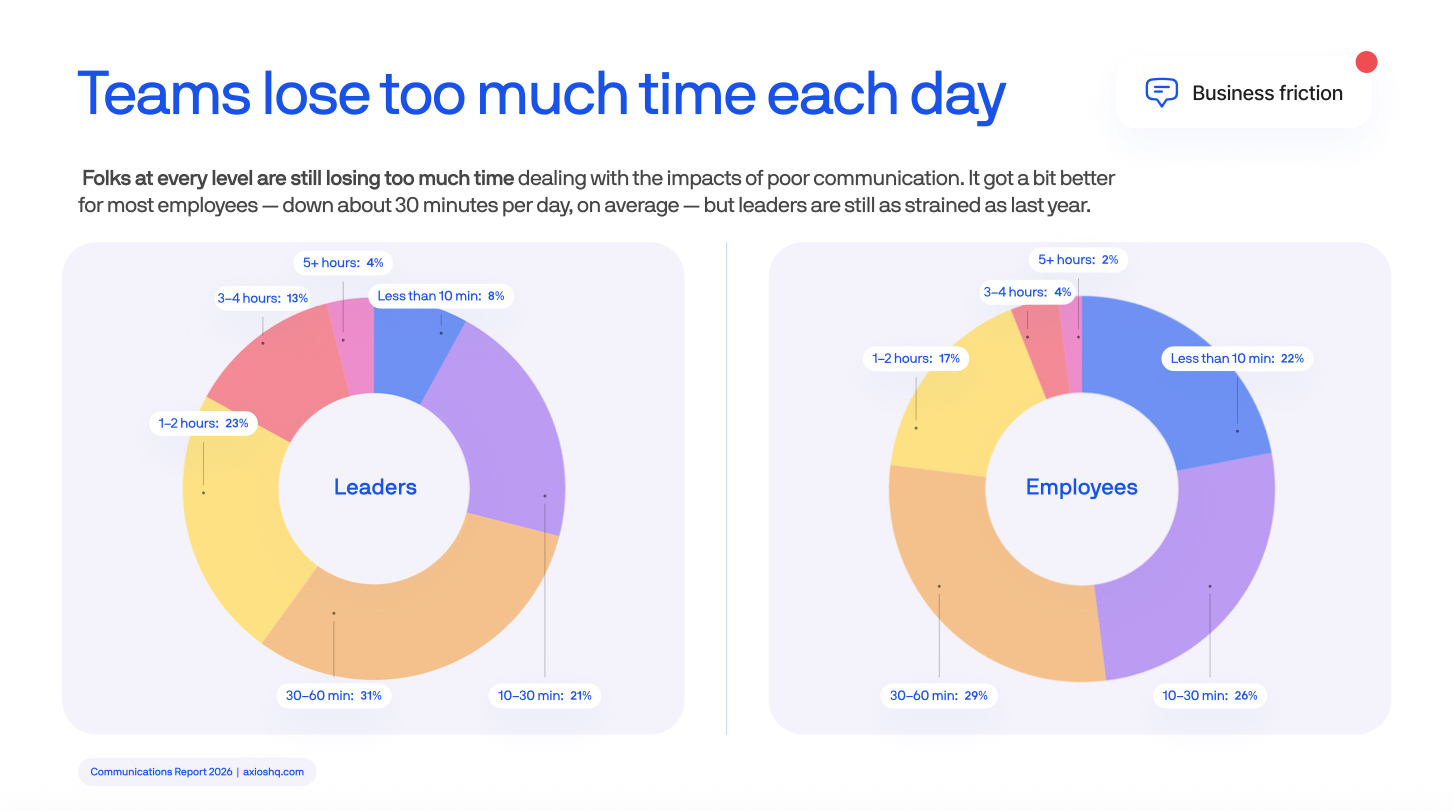
Axios HQ's 2026 report puts a price tag on bad communication most CFOs have never seen. Employees earning $200,000 or more lose 60+ workdays a year to unclear, untimely, or uncoordinated communication. That's $51,790 in salary equivalent. Per person. Up 17 days from last year.
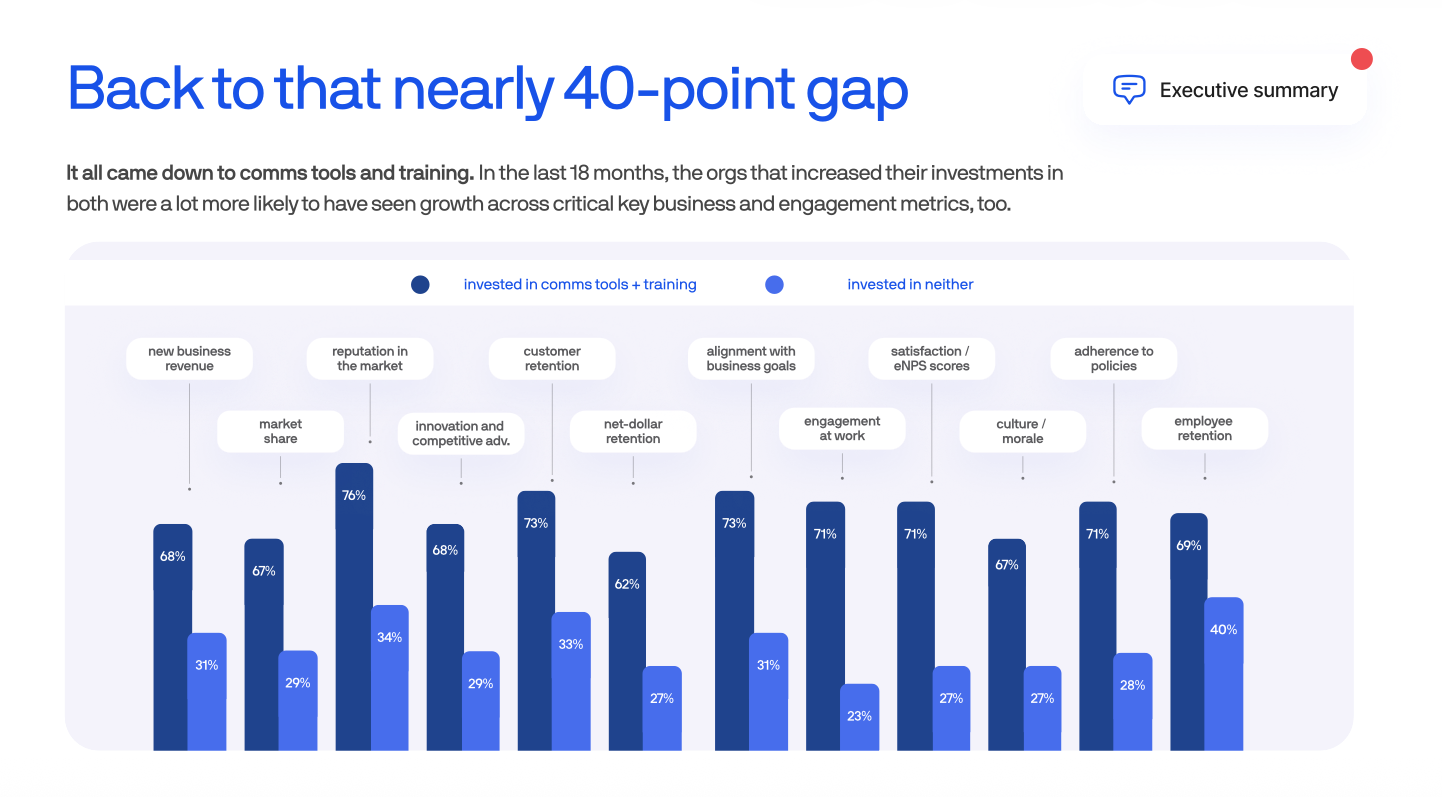
This is not a culture cost. It is an execution cost. It explains the report's headline finding: a 40-point performance gap between organizations that invested in communication tools and training and those that did not. Revenue, market share, retention, reputation, employee engagement. All of it. Forty points of compounded performance hiding in plain sight.
Spending doesn’t close a capability gap
The typical fix is to throw money at platforms. A new newsletter tool. An AI-powered content engine. Slack channels organized by topic. Most organizations have done some version of this and called it an investment in communication.
But it hasn't worked. The report shows training is the multiplier. Organizations that paired tools with structured communication training drove significantly more behavior change. High performers were three to five times more confident in their training strategy than laggards.
There is a more subtle problem underneath. Communications teams are caught in the whirlwind of volume. Artificial Intelligence was supposed to give us back time. Instead, that time is going to more emails and more messages, not better decisions. The strategic opportunity AI created is being spent on output, not impact.
Cross-functional visibility is a strategic asset
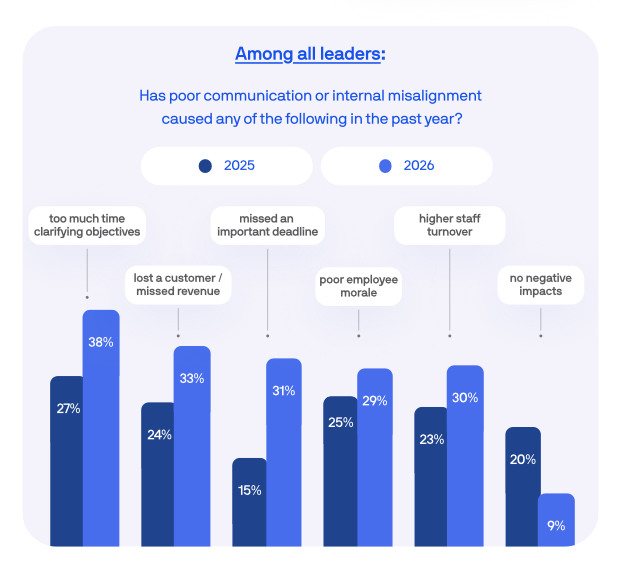
The volume of change inside organizations has never been higher. Gartner data published in HBR shows the average employee experienced 10 planned enterprise changes in 2022, up from two in 2016. Five times the volume in six years. Over the same period, employee willingness to support change fell from 74 percent to 43 percent.
Employees are burned out and disengaged. They cannot absorb another transformation on top of the ones already in flight. These are not communication statistics. They are operating statistics with communication consequences.
Change saturation is the symptom. The underlying problem is that no single function has cross-organizational visibility into what employees are being asked to absorb. HR sees the people lane. IT sees the systems lane. The CFO sees the spend. The CEO sees the strategy. None of them sees the full picture employees actually live every day.
Communicators do. By default. We are the one group with oversight across every initiative running in the company. We can see when two transformations are about to collide, when an HR change conflicts with an IT rollout, when employees are about to be hit with three campaigns in the same week. We can sequence initiatives whose owners do not know they are competing for the same attention.
But the asset only matters if the function has the authority to act on it. When communications is embedded inside another function (HR, Marketing, IT), the visibility gets trapped. The team loses its standing to influence the enterprise. The work becomes harder than it ever needed to be.
Reporting structure is the strategy
The report's sharpest data point: 60 percent of high performers say their Comms team has significant influence on strategic decisions. Among low performers, 20 percent. High performers are also far more likely to have communications reporting to the CEO.
Communications should report to the CEO. Not because we deserve the seat, but because the function works better there. We can shape strategy before it sets. We can stop decisions that conflict with priorities already in motion or that the business cannot execute cleanly.
The real shift is not the title. It is how the function operates. Treat communications as a line function with a business leader, not a staff function with an advisor. Four markers separate the two in practice.
A business leader owns a number. Productivity, retention, change adoption velocity, time-to-clarity on enterprise decisions. Not message volume or campaign output.
A business leader allocates capital. Budget, headcount, vendor spend. Tied to measurable outcomes and held to the return.
A business leader has the standing to stop a decision before it gets made when the data says it cannot be executed cleanly. Not translate it after the fact.
A business leader sits in the room before the decision is made. Not in the meeting after, drafting the email.
From advisor to owner
Communications and strategy should be aligned. Often they are not. The 40-point performance gap is not solved at the editorial calendar. It is solved at the org chart. Companies that want the next five years to look different from the last five will not get there by sending fewer emails or buying better tools. They will get there by treating communication as a business outcome, not a support function, and hiring a business leader to own it.
The question every executive team should be asking is not "what should our Comms team do." It is "who is our business leader for communications, what number do they own, and where do they sit when decisions get made."
We are not strategic advisors. We are business leaders. The org chart should say so.
Written by Erin Abbey, founder of Abbey Communications Group, a strategic communications and enterprise change consultancy. After two decades leading communications at global organizations, she believes compassion and performance are not opposites. The strongest work proves they belong together.