

Your engagement score is lying to you
Most employees say they're engaged. Nearly half are already looking for their next job. Both of those things are true at the same time, and that tension is the core finding in two new reports from Firstup, who surveyed more than 6,200 employees across North America and the United Kingdom.
I reviewed both reports and had a chance to talk through them on Frequency this week. The data is worth sitting with.
Download the reports: UK | North America
The engagement numbers look fine. The retention numbers do not.
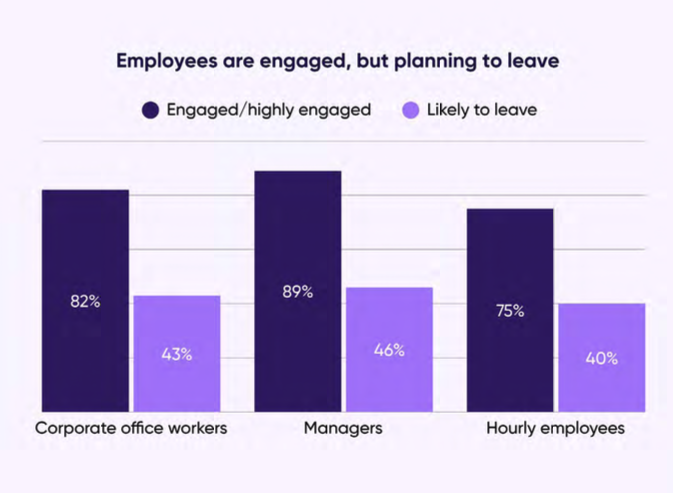
In North America, 82 percent of corporate office workers, 89 percent of managers, and 75 percent of hourly workers describe themselves as engaged or highly engaged. Headline numbers that would make most leadership teams feel pretty good.
Then the other numbers: 43 percent of those same engaged corporate office workers, 46 percent of managers, and 40 percent of hourly employees say they're likely to look for a new job within the next 12 months.
The UK numbers follow the same pattern with a bit more urgency. Engagement sits at 76 to 83 percent across roles. Intent to leave sits at 47 to 50 percent. Higher across the board than North America.
I have a theory about why, and I'll be upfront that it's a gut read, not a finding from the data. In the US, your benefits and healthcare are tied to your job. Most people won't leave until they have something lined up, because the gap in coverage isn't a risk they're willing to take. That's not engagement. That's a financial calculation. And it's keeping people in seats the engagement score then misreads as loyalty.
The UK doesn't work that way. Leave your job in the UK and your healthcare doesn't disappear. So when a UK employee is unhappy, the math for walking out is different. Canada sits somewhere in the middle with universal healthcare, and I'd be curious whether those numbers skew differently from the US within the North America sample.
The upshot: if you're comparing UK and North American intent-to-leave numbers and concluding your US workforce is more committed, you may be measuring something else entirely.
Engagement and intent to stay are no longer the same signal. Organizations that treat one as a proxy for the other are flying with incomplete instruments.
The communication problem hiding in plain sight
Both reports point to the same structural driver underneath the retention risk: organizations are not delivering critical information reliably.
In North America, 61 to 67 percent of employees across roles report missing an important policy or procedural update. In the UK, that number runs from 62 to 76 percent, with UK managers topping out at 76 percent compared to 70 percent in North America.
This is happening while most employees say they receive updates at least weekly. The problem is not volume. It's effectiveness. Messages are going out. Employees are still missing them because what gets sent is poorly targeted, buried in noise, or delivered through channels that don't match how people actually work.
The downstream consequences are measurable. Miscommunication drives stress for around 44 percent of employees across both regions. It drives productivity loss in 32 to 40 percent of cases. For roughly one in four employees, it's a specific reason they want to find a new job.
The manager bottleneck is getting worse
Managers are the most trusted source of workplace information across every role in both markets. They are also the most overloaded, and the data shows the gap is wider in the UK.
In North America, 70 percent of managers report challenges communicating effectively with hourly teams. Only 29 percent feel confident their communication approach keeps workers compliant with required policies.
In the UK: 77 percent of managers report the same challenges. Only 21 percent feel confident.
Organizations have built a communication model that depends heavily on managers to cascade critical information while simultaneously under-equipping them to do it. When a manager who lacks time, tools, and a clear system is the primary channel for policy updates, safety information, and schedule changes, variability is guaranteed.
Trust in leadership compounds this. Only 16 percent of hourly employees in North America trust corporate leadership as a source of workplace information. In the UK it runs from 11 to 19 percent. When leadership has that little credibility as an information source, managers carry even more of the weight.
What employees are asking for
Across 6,200 employees, two countries, and three role types, the top three things people want beyond pay are nearly identical:
Show me you care. Improve communication with me. Give me better tools.
That consistency is striking. The ask is not complicated. Employees are not demanding transformation programs or elaborate engagement initiatives. They want to feel like the organization is paying attention to them and to receive information that is clear, relevant, and reliable.
The AI gap is an access problem
Sixty percent of hourly workers in North America have never used AI tools at work. In the UK, that number is 68 percent. In both markets, the primary reason is not skepticism or resistance. It's lack of access.
The UK report makes a pointed observation on this: the dominant narrative that older workers resist AI isn't borne out by the data. Across nearly every age group, from 25 to 65+, the top barrier is access. The workforce segments most affected by communication breakdowns are also the least enabled to use the tools that could help close those gaps.
One finding unique to the UK report: Gen Z employees ages 18 to 24 are the most likely group to report stress due to miscommunication, and 31 percent receive workplace information through mobile channels. If the communication infrastructure isn't built for mobile, organizations are already behind with the employees who are just entering the workforce.
What this adds up to
The engagement score is not the signal it used to be. . . or even what we thought it was. Both reports make that clear with data, not opinion. Organizations can report healthy engagement while absorbing real attrition risk, measurable productivity loss, compliance exposure, and a manager bottleneck that compounds every one of those problems.
The gap between what employees experience and what the dashboard shows is a communication infrastructure problem. And it's one communicators are positioned to name, to measure, and to fix.
Written by Chuck Gose, founder of ICology.
August 27, 2026 · Sioux Falls, SD
Flyover Festival is where IC gets together.
One full day of workshops, peer connections, and creative breakthroughs. 45 tickets. Members save $200.